How does an LLM turn my question into an answer?

While learning how LLMs work, I kept coming back to a few questions. If the model only takes numbers, what happens to my text? Why can it process the question together, but generate the answer one token at a time? Does it process the whole question again at every step?

I turned that learning into this 8-page comic. It follows one question about a cat through token IDs, sampling, weights, prefill, decode and KV caching.

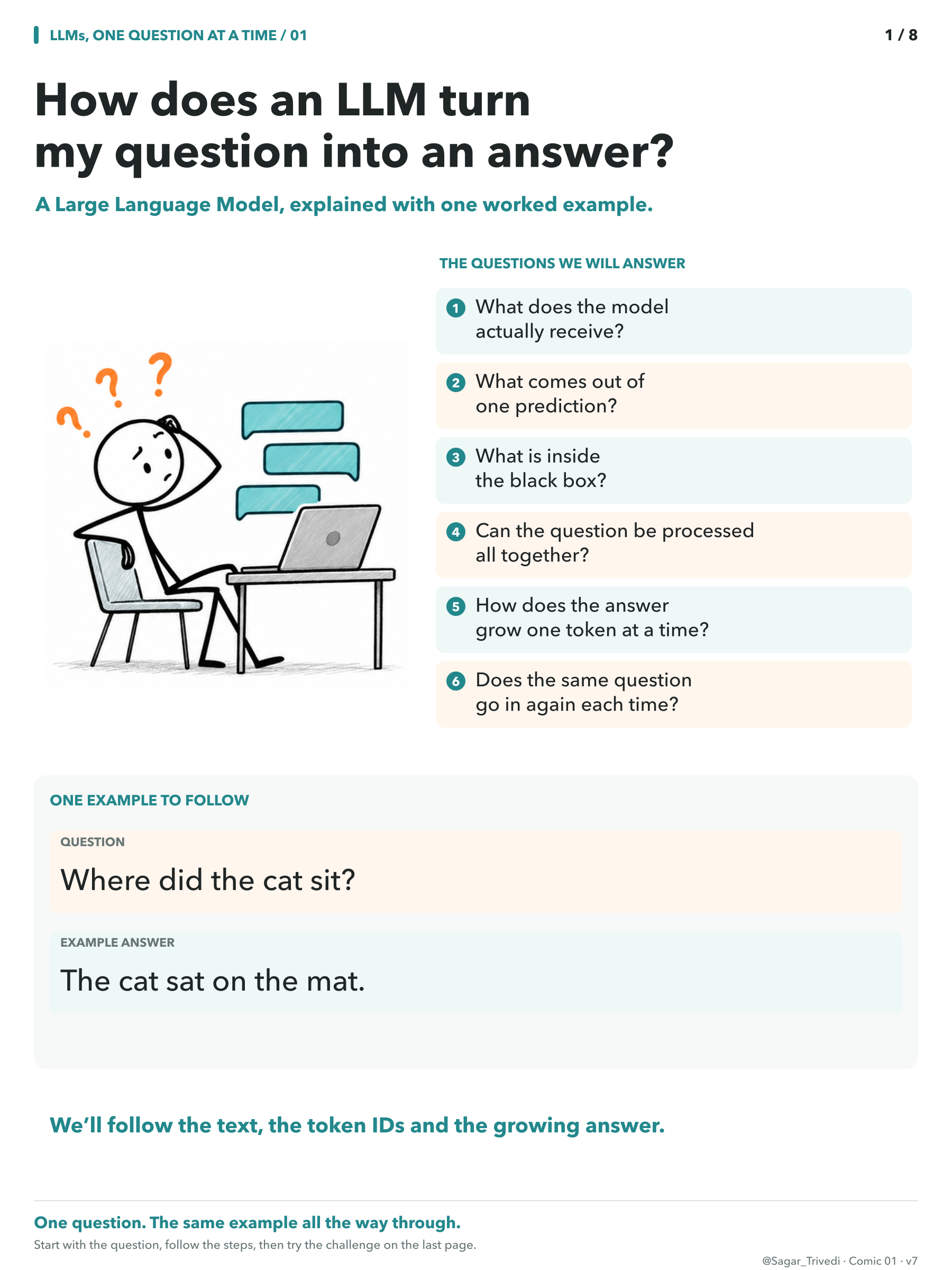
Comic page 1 of 8: How does an LLM turn my question into an answer?
Read page 1 as text

One question. The same example all the way through.

Start with the question, follow the steps, then try the challenge on the last page.

How does an LLM turn

my question into an answer?

A Large Language Model, explained with one worked example.

THE QUESTIONS WE WILL ANSWER

What does the model

actually receive?

What comes out of

one prediction?

What is inside

the black box?

Can the question be processed

all together?

How does the answer

grow one token at a time?

Does the same question

go in again each time?

ONE EXAMPLE TO FOLLOW

QUESTION

Where did the cat sit?

EXAMPLE ANSWER

The cat sat on the mat.

We’ll follow the text, the token IDs and the growing answer.

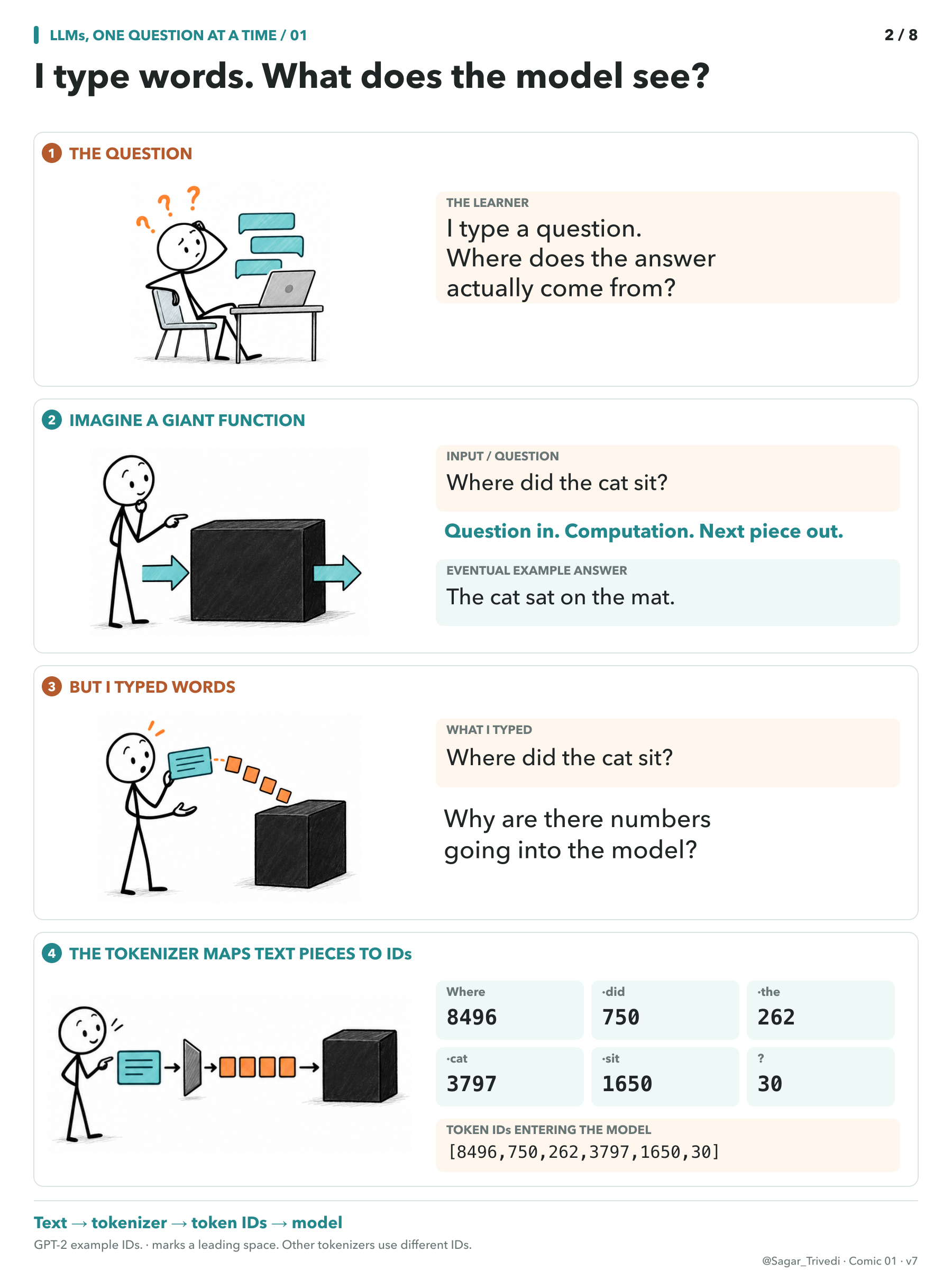
Comic page 2 of 8: I type words. What does the model see?
Read page 2 as text

I type words. What does the model see?

Text → tokenizer → token IDs → model

GPT-2 example IDs. · marks a leading space. Other tokenizers use different IDs.

THE QUESTION

THE LEARNER

I type a question.

Where does the answer

actually come from?

IMAGINE A GIANT FUNCTION

INPUT / QUESTION

Where did the cat sit?

Question in. Computation. Next piece out.

EVENTUAL EXAMPLE ANSWER

The cat sat on the mat.

BUT I TYPED WORDS

WHAT I TYPED

Where did the cat sit?

Why are there numbers

going into the model?

THE TOKENIZER MAPS TEXT PIECES TO IDs

Where

·did

·the

·cat

·sit

?

TOKEN IDs ENTERING THE MODEL

[8496,750,262,3797,1650,30]

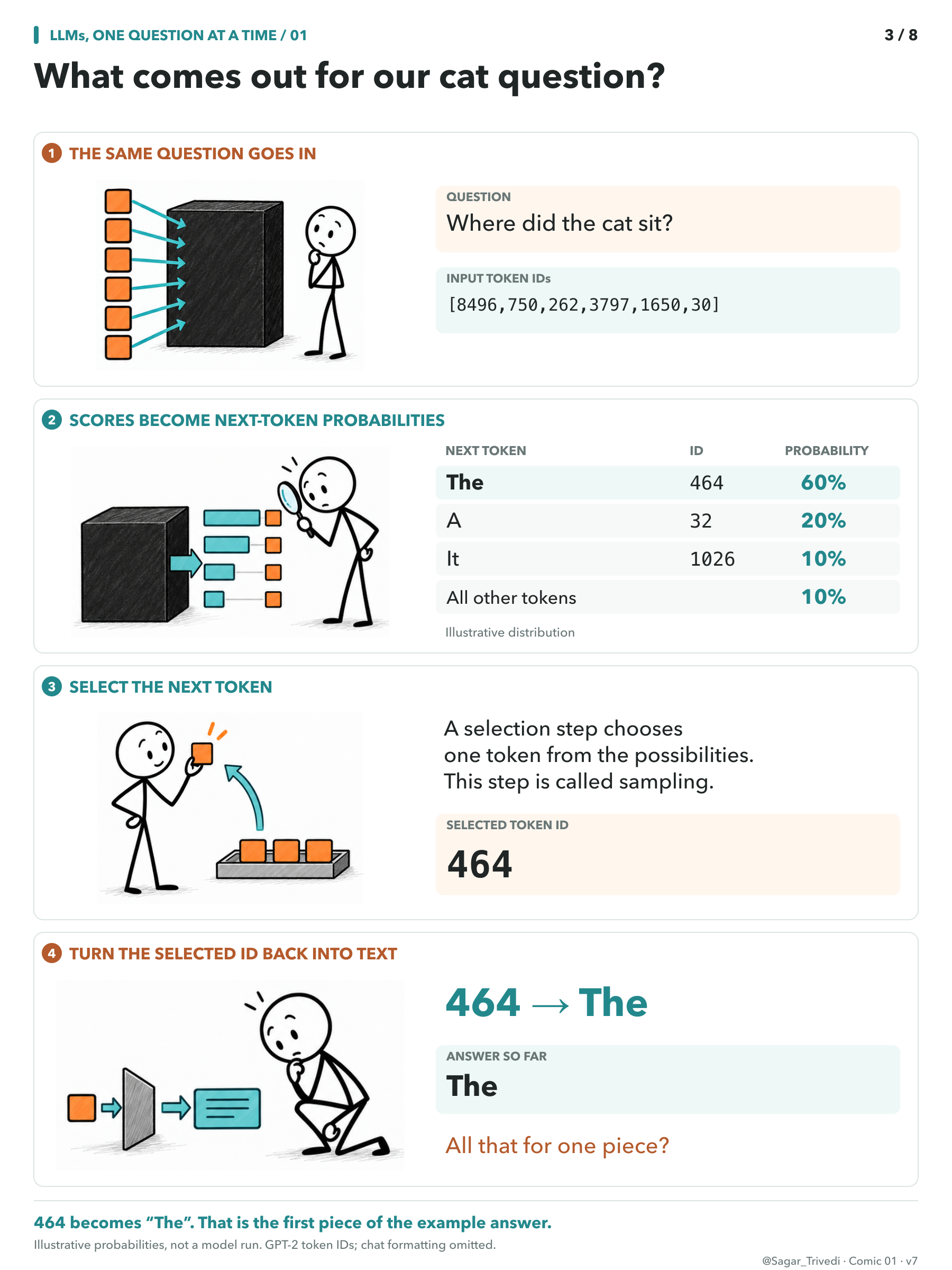
Comic page 3 of 8: What comes out for our cat question?
Read page 3 as text

What comes out for our cat question?

464 becomes “The”. That is the first piece of the example answer.

Illustrative probabilities, not a model run. GPT-2 token IDs; chat formatting omitted.

THE SAME QUESTION GOES IN

QUESTION

Where did the cat sit?

INPUT TOKEN IDs

[8496,750,262,3797,1650,30]

SCORES BECOME NEXT-TOKEN PROBABILITIES

NEXT TOKEN

ID

PROBABILITY

The

60%

A

20%

It

10%

All other tokens

10%

Illustrative distribution

SELECT THE NEXT TOKEN

A selection step chooses

one token from the possibilities.

This step is called sampling.

SELECTED TOKEN ID

TURN THE SELECTED ID BACK INTO TEXT

464 → The

ANSWER SO FAR

The

All that for one piece?

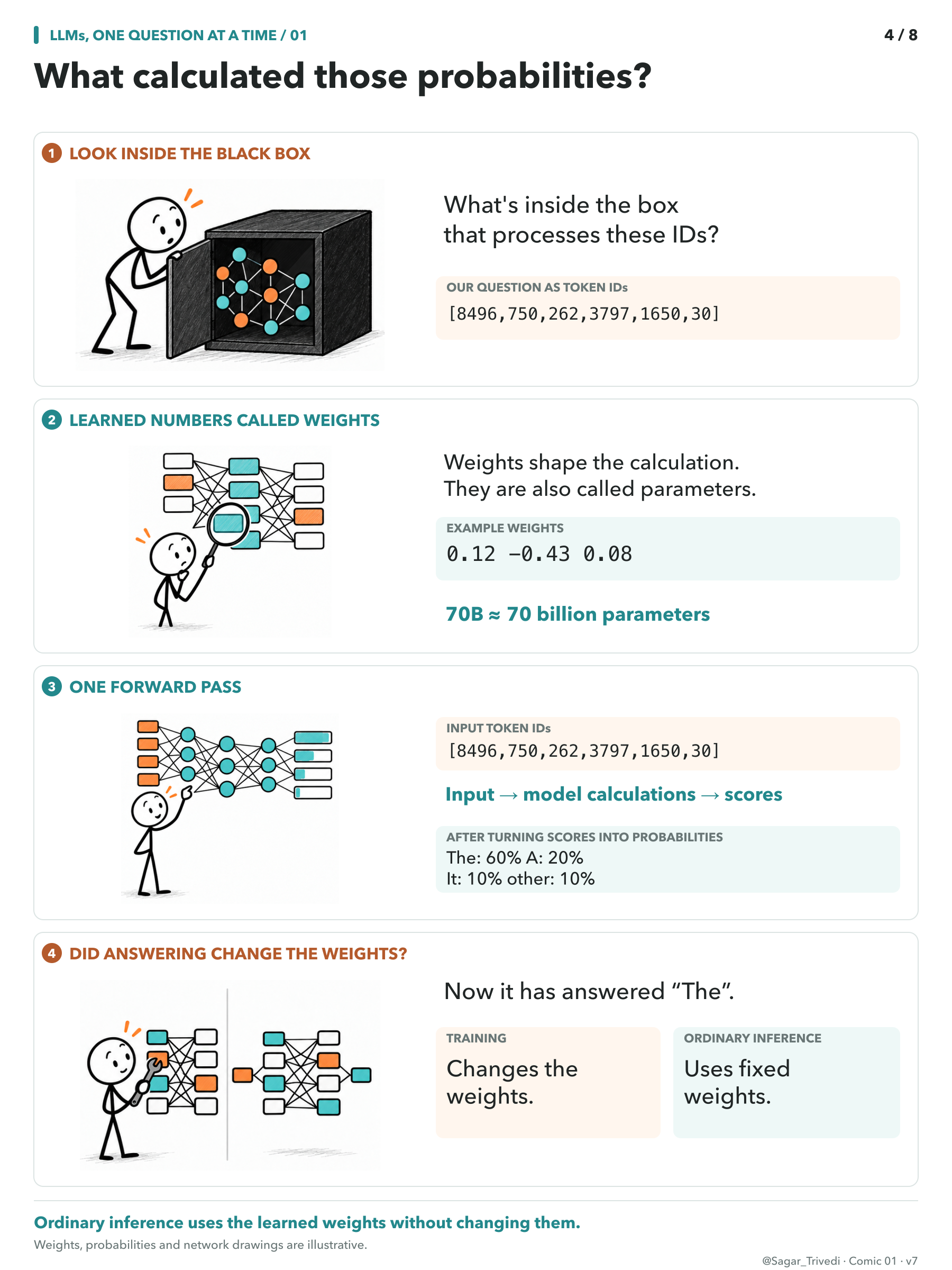
Comic page 4 of 8: What calculated those probabilities?
Read page 4 as text

What calculated those probabilities?

Ordinary inference uses the learned weights without changing them.

Weights, probabilities and network drawings are illustrative.

LOOK INSIDE THE BLACK BOX

What's inside the box

that processes these IDs?

OUR QUESTION AS TOKEN IDs

[8496,750,262,3797,1650,30]

LEARNED NUMBERS CALLED WEIGHTS

Weights shape the calculation.

They are also called parameters.

EXAMPLE WEIGHTS

0.12 -0.43 0.08

70B ≈ 70 billion parameters

ONE FORWARD PASS

INPUT TOKEN IDs

[8496,750,262,3797,1650,30]

Input → model calculations → scores

AFTER TURNING SCORES INTO PROBABILITIES

The: 60% A: 20%

It: 10% other: 10%

DID ANSWERING CHANGE THE WEIGHTS?

Now it has answered “The”.

TRAINING

Changes the

weights.

ORDINARY INFERENCE

Uses fixed

weights.

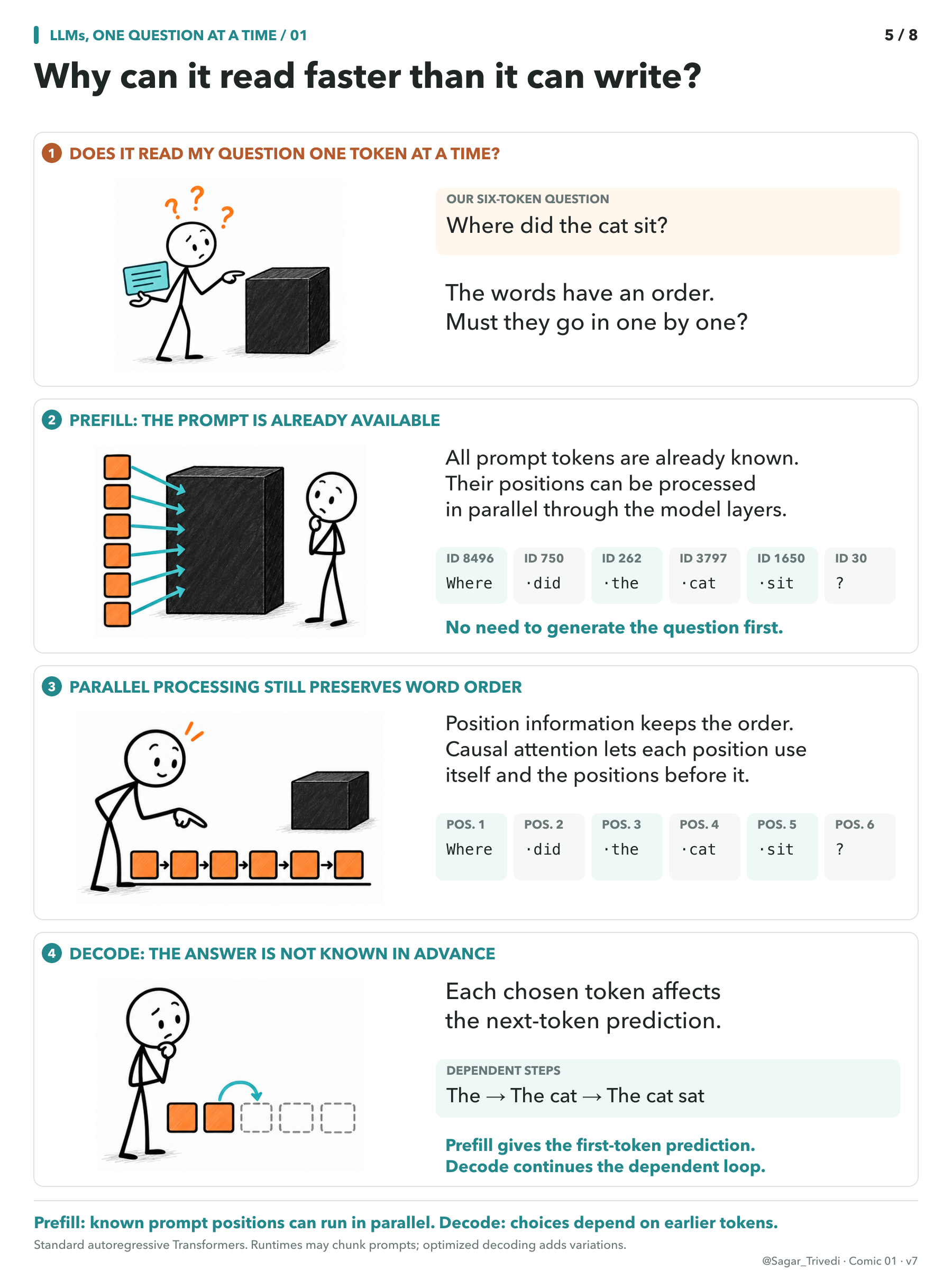
Comic page 5 of 8: Why can it read faster than it can write?
Read page 5 as text

Why can it read faster than it can write?

Prefill: known prompt positions can run in parallel. Decode: choices depend on earlier tokens.

Standard autoregressive Transformers. Runtimes may chunk prompts; optimized decoding adds variations.

DOES IT READ MY QUESTION ONE TOKEN AT A TIME?

OUR SIX-TOKEN QUESTION

Where did the cat sit?

The words have an order.

Must they go in one by one?

PREFILL: THE PROMPT IS ALREADY AVAILABLE

All prompt tokens are already known.

Their positions can be processed

in parallel through the model layers.

ID 8496

Where

ID 750

·did

ID 262

·the

ID 3797

·cat

ID 1650

·sit

ID 30

?

No need to generate the question first.

PARALLEL PROCESSING STILL PRESERVES WORD ORDER

Position information keeps the order.

Causal attention lets each position use

itself and the positions before it.

POS. 1

Where

POS. 2

·did

POS. 3

·the

POS. 4

·cat

POS. 5

·sit

POS. 6

?

DECODE: THE ANSWER IS NOT KNOWN IN ADVANCE

Each chosen token affects

the next-token prediction.

DEPENDENT STEPS

The → The cat → The cat sat

Prefill gives the first-token prediction.

Decode continues the dependent loop.

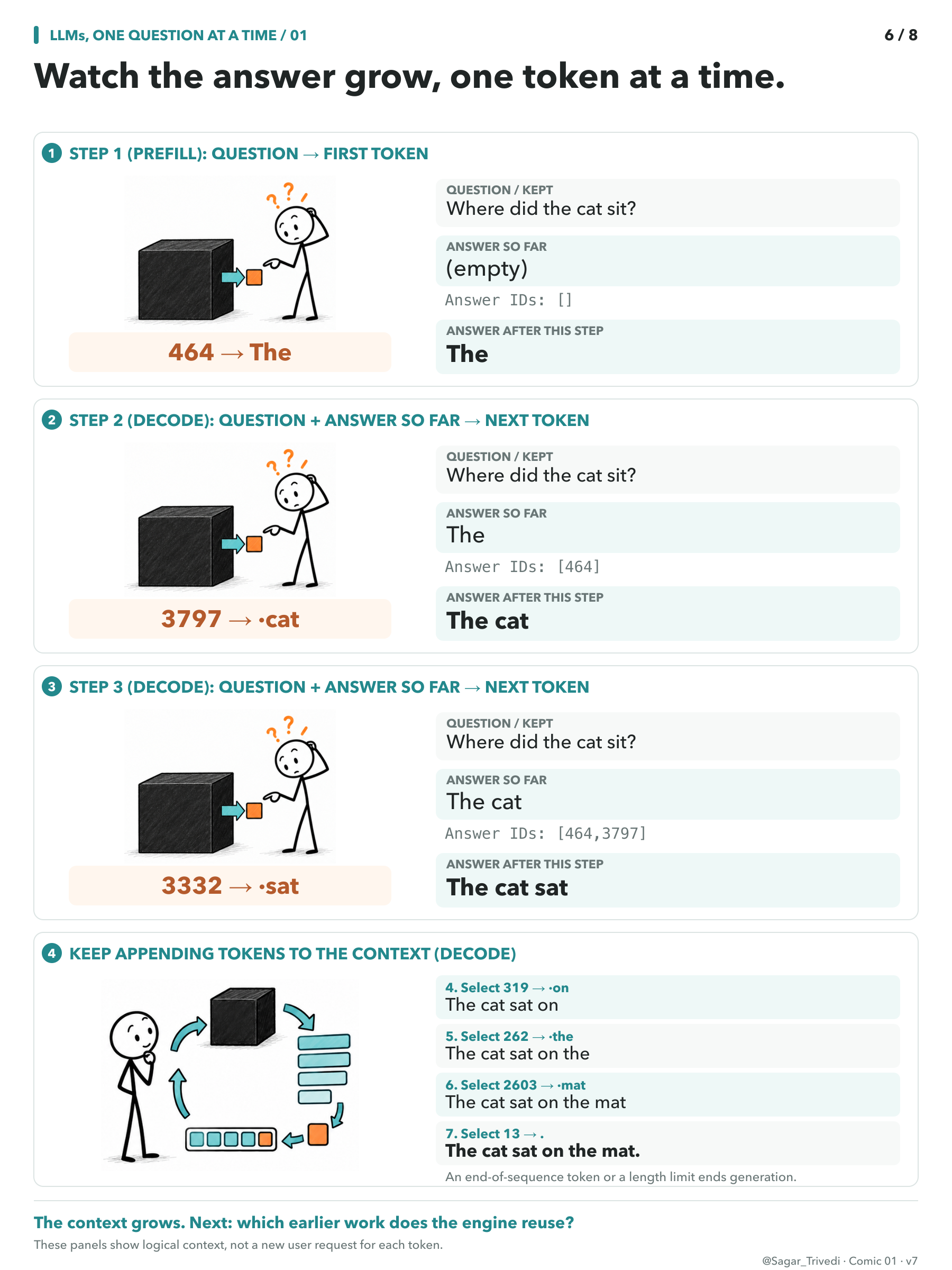
Comic page 6 of 8: Watch the answer grow, one token at a time.
Read page 6 as text

Watch the answer grow, one token at a time.

The context grows. Next: which earlier work does the engine reuse?

These panels show logical context, not a new user request for each token.

STEP 1 (PREFILL): QUESTION → FIRST TOKEN

464 → The

QUESTION / KEPT

Where did the cat sit?

ANSWER SO FAR

(empty)

Answer IDs: []

ANSWER AFTER THIS STEP

The

STEP 2 (DECODE): QUESTION + ANSWER SO FAR → NEXT TOKEN

3797 → ·cat

QUESTION / KEPT

Where did the cat sit?

ANSWER SO FAR

The

Answer IDs: [464]

ANSWER AFTER THIS STEP

The cat

STEP 3 (DECODE): QUESTION + ANSWER SO FAR → NEXT TOKEN

3332 → ·sat

QUESTION / KEPT

Where did the cat sit?

ANSWER SO FAR

The cat

Answer IDs: [464,3797]

ANSWER AFTER THIS STEP

The cat sat

KEEP APPENDING TOKENS TO THE CONTEXT (DECODE)

4. Select 319 → ·on

The cat sat on

5. Select 262 → ·the

The cat sat on the

6. Select 2603 → ·mat

The cat sat on the mat

7. Select 13 → .

The cat sat on the mat.

An end-of-sequence token or a length limit ends generation.

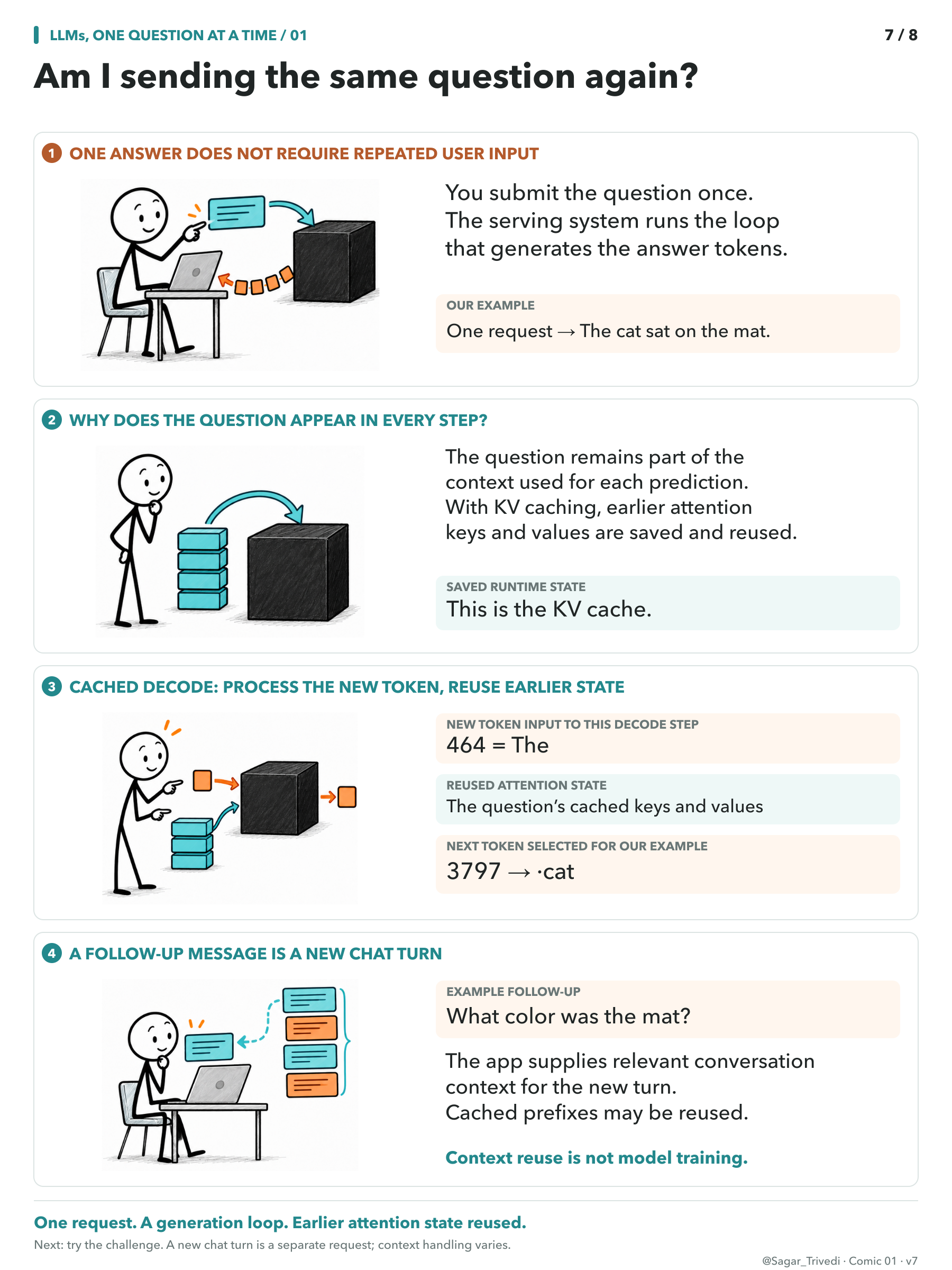
Comic page 7 of 8: Am I sending the same question again?
Read page 7 as text

Am I sending the same question again?

One request. A generation loop. Earlier attention state reused.

Next: try the challenge. A new chat turn is a separate request; context handling varies.

ONE ANSWER DOES NOT REQUIRE REPEATED USER INPUT

You submit the question once.

The serving system runs the loop

that generates the answer tokens.

OUR EXAMPLE

One request → The cat sat on the mat.

WHY DOES THE QUESTION APPEAR IN EVERY STEP?

The question remains part of the

context used for each prediction.

With KV caching, earlier attention

keys and values are saved and reused.

SAVED RUNTIME STATE

This is the KV cache.

CACHED DECODE: PROCESS THE NEW TOKEN, REUSE EARLIER STATE

NEW TOKEN INPUT TO THIS DECODE STEP

464 = The

REUSED ATTENTION STATE

The question’s cached keys and values

NEXT TOKEN SELECTED FOR OUR EXAMPLE

3797 → ·cat

A FOLLOW-UP MESSAGE IS A NEW CHAT TURN

EXAMPLE FOLLOW-UP

What color was the mat?

The app supplies relevant conversation

context for the new turn.

Cached prefixes may be reused.

Context reuse is not model training.
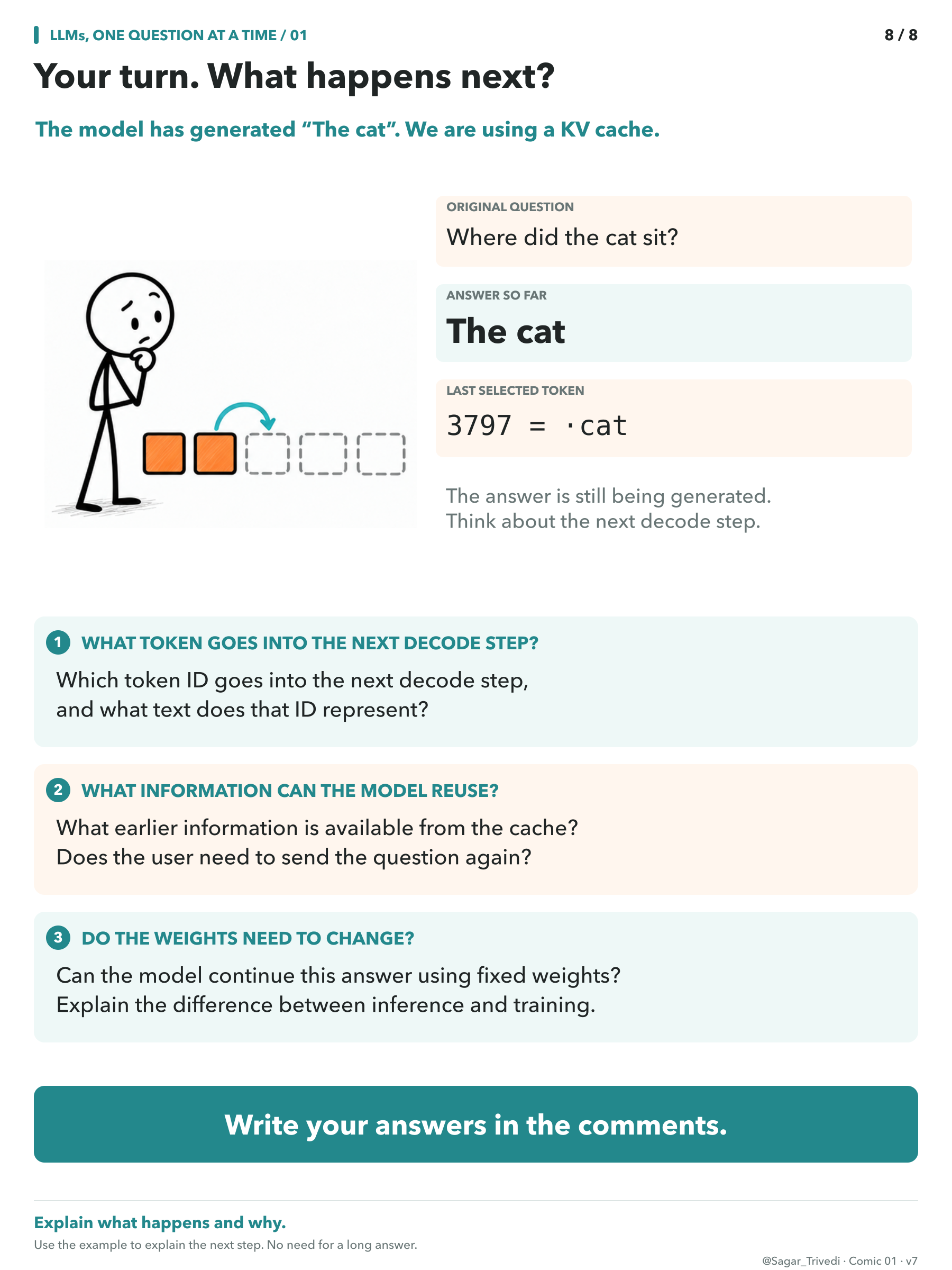
Comic page 8 of 8: Your turn. What happens next?
Read page 8 as text

Your turn. What happens next?

Explain what happens and why.

Use the example to explain the next step. No need for a long answer.

The model has generated “The cat”. We are using a KV cache.

ORIGINAL QUESTION

Where did the cat sit?

ANSWER SO FAR

The cat

LAST SELECTED TOKEN

3797 = ·cat

The answer is still being generated.

Think about the next decode step.

WHAT TOKEN GOES INTO THE NEXT DECODE STEP?

Which token ID goes into the next decode step,

and what text does that ID represent?

WHAT INFORMATION CAN THE MODEL REUSE?

What earlier information is available from the cache?

Does the user need to send the question again?

DO THE WEIGHTS NEED TO CHANGE?

Can the model continue this answer using fixed weights?

Explain the difference between inference and training.

Write your answers in the comments.

The last page ends with a challenge. Add your explanation to the post on LinkedIn.